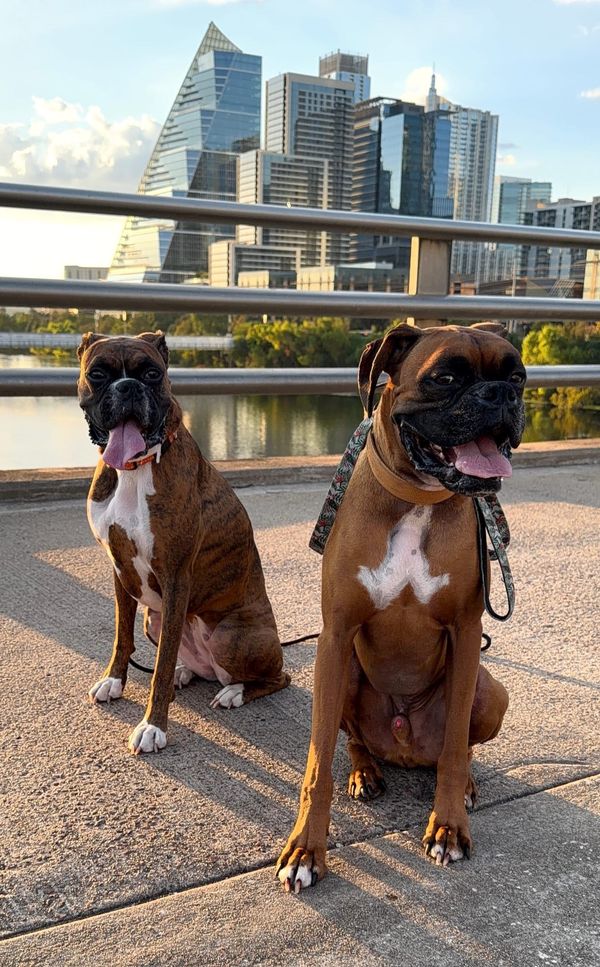
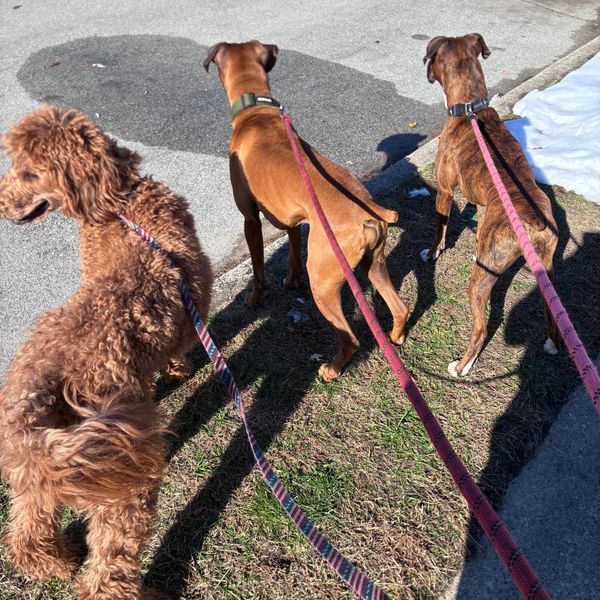
My Boxer Pulls Everywhere: The Boxer-Specific Guide to Loose-Leash Walking
Your Boxer is not too strong to learn. Discover why pulling works, how to stop rewarding it, and how to teach calm, connected walking one successful step at a time.

You clip on the leash.
Your Boxer launches toward the door.
The walk has not officially started, but your shoulder has already received the announcement.
Then come the smells, squirrels, people, dogs, bushes, and apparently the most fascinating patch of grass in North America.
If this sounds familiar, here is the first thing I want you to know:
Your Boxer is not too strong, too energetic, or too stubborn to learn loose-leash walking.
Pulling usually continues because it works. The tight leash carries your Boxer toward the thing they want. Every successful surge can teach the same lesson:
Pressure on the leash makes the world move closer.
We are going to teach the opposite lesson:
A loose leash opens the world. Pulling pauses access to it.
That is the foundation of the Boxer Bond loose-leash system.
Why Boxers Pull So Hard
The Boxer is bright, active, playful, athletic, and intensely interested in whatever is happening around them. The American Kennel Club’s Boxer profile describes the breed as energetic, while the American Boxer Club notes that Boxers enjoy both physical and mental challenges.
That does not doom you to being dragged down the street. It does explain why a slow human walk through a high-value environment can be difficult.
Your Boxer may pull because:
- forward movement is rewarding;
- smells and social opportunities are rewarding;
- their natural walking pace is faster than yours;
- nobody has clearly taught what leash pressure means;
- they are already overexcited before leaving home;
- pulling has worked for months or years;
- they are anxious or reactive around specific triggers;
- or the walk provides too little opportunity to sniff and explore appropriately.
Notice what is missing from that list: a plot to dominate you.
Loose-leash walking is a trained skill—not a moral quality.
Loose-Leash Walking Is Not Formal Heel
A formal heel asks a dog to maintain a precise position, usually beside one leg, with focused attention. That is valuable for short periods and specific situations.
A pleasant daily walk is different.
For most Boxer owners, success looks like:
- a relaxed J-shaped leash;
- no sustained dragging;
- the ability to pass ordinary distractions safely;
- regular check-ins;
- permission to sniff when released;
- and a dog who can adjust to the handler’s direction.
Your Boxer does not need to stare at your face for the entire walk. They need to remain connected enough that both of you can move safely together.
The Equipment I Recommend
Start with simple, well-fitted equipment:
- a sturdy six-foot leash;
- a comfortable, properly fitted harness or flat collar appropriate for your dog;
- high-value, pea-sized treats;
- and a treat pouch you can reach quickly.
A front-clip harness may give some owners more mechanical control while training, but equipment manages leverage—it does not teach the behavior by itself.
Avoid retractable leashes during early loose-leash instruction. They maintain tension and make it harder to teach a consistent walking zone. The AKC’s current leash-training guide similarly recommends a manageable leash and emphasizes rewarding the dog for staying near you.
If your Boxer has coughing, breathing difficulty, neck pain, orthopedic concerns, or an unusual gait, ask your veterinarian which walking equipment is safest.
Step 1: Define the Reward Zone
Choose the side on which you want your Boxer to walk most often.
This is not a permanent restriction. It simply gives the dog a clear place where rewards reliably appear.
Stand still in a quiet room. When your Boxer comes beside your chosen leg:
- Mark the moment with “yes” or a click.
- Deliver the treat beside your leg—not out in front.
- Take one step.
- Mark and reward again if the leash remains loose.
Your delivery location matters. If treats always appear in front of your knees, you may accidentally teach your Boxer to cut across you or forge ahead.
Begin with one or two successful steps. Do not wait for failure before rewarding.
Step 2: Teach That Leash Pressure Is Information
Many dogs experience leash pressure and instinctively push against it. Your goal is to make light pressure a cue to return toward you—not a contest of strength.
In a quiet space:
- Apply the lightest steady pressure to the side.
- The moment your Boxer shifts toward the pressure, mark.
- Release the pressure immediately.
- Reward beside you.
Do not jerk the leash. Do not drag your dog into position. We want your Boxer actively solving the puzzle.
Practice from several gentle angles until the feeling of tension prompts your Boxer to reorient toward you.
Step 3: Make a Loose Leash Move the Walk Forward
Now establish the clearest rule in the system:
Loose leash = movement continues
Tight leash = movement pauses
When the leash tightens, stop. Wait for your Boxer to turn, step back, or otherwise create slack. Mark that choice, reward near your leg, and resume walking.
The AKC’s guidance on leash pulling explains the same learning principle: if pulling continues to move the dog forward, pulling is being rewarded.
There is one important nuance. Do not stand frozen for five minutes while your Boxer hangs at the end of the leash. If they cannot disengage, the environment may be too difficult. Cheerfully move backward, change direction, or increase distance from the distraction and try again.
We are teaching—not entering a staring contest.
Step 4: Reward Check-Ins Before You Need Them
Outside, your Boxer glances at you without being asked.
Mark and reward.
They feel the leash shift and turn with you.
Mark and reward.
They notice a smell but keep the leash loose.
Mark and reward.
These small choices are the architecture of a good walk.
Owners often ignore 20 seconds of beautiful walking and respond only when the dog pulls. That makes the training conversation almost entirely about mistakes.
Become generous with information when your Boxer is right.
Step 5: Use Sniffing as Payment
Food is useful, but it is not your only reward.
Suppose your Boxer wants to reach a tree.
Wait for a moment of slack. Ask for two or three connected steps. Then say:
“Go sniff!”
Move together toward the tree.
Now the environment is paying your Boxer for walking politely. This is sometimes called a life reward: access to a normal activity the dog genuinely wants.
Your training becomes much more powerful when you stop competing with the entire world and start controlling thoughtful access to it.
Step 6: Add Direction Changes
Teach a cheerful cue such as “this way!”
Say it before turning. Move with purpose, and reward when your Boxer catches up beside you.
Practice:
- U-turns;
- left and right turns;
- slow walking;
- several quick steps;
- and brief stops.
Keep it playful. Boxers often respond beautifully when training contains motion, variety, and interaction rather than repetitive marching.
A practiced U-turn also becomes a valuable safety tool when an off-leash dog, narrow sidewalk, or other problem appears ahead.
Step 7: Lower Arousal Before the Door Opens
The walk begins before you leave.
If the leash predicts frantic spinning, barking, door charging, and an explosive launch, your Boxer begins the walk already overexcited.
Practice the pieces separately:
- pick up the leash, then put it down;
- clip it on, reward calmness, and remove it;
- walk toward the door, then turn away;
- touch the handle and reward four paws on the floor;
- open the door slightly, close it, and reward calmness;
- release through the doorway only when the leash is loose.
This is not about demanding a statue-still dog. It is about rehearsing a nervous system that can remain functional around the start-of-walk routine.

Build a Boxer Distraction Ladder
Do not teach five good steps in the kitchen and immediately expect a mile beside squirrels.
Progress through levels:
- Living room
- Hallway or driveway
- Quiet sidewalk
- Familiar route at a quiet time
- Park at a distance from activity
- People or dogs far away
- More movement, novelty, and tighter spaces
Advance when your Boxer can succeed consistently—not because the calendar says it is time.
If performance collapses, reduce distance, duration, or distraction.
A Seven-Day Loose-Leash Reset
Day 1: Reward-zone practice
Three sessions of two minutes indoors.
Day 2: Leash-pressure game
Teach turning toward light pressure. Add five to ten steps indoors.
Day 3: Doorway calmness
Rehearse leash pickup, clipping, and calm exits without taking a full walk every time.
Day 4: Quiet outdoor repetitions
Train for five minutes in the lowest-distraction outdoor area available.
Day 5: Life rewards
Use short stretches of loose-leash walking to earn sniffing.
Day 6: Direction changes
Practice your U-turn and “this way” cue before you need them.
Day 7: Combine the system
Take one short training walk. Measure success by connection and leash slack—not distance traveled.
Common Mistakes That Keep Boxers Pulling
Only training when you need a long walk
When you are late or trying to exhaust the dog, your patience disappears. Separate five-minute training sessions from some of your exercise outings.
Expecting equipment to solve the problem
A harness can help you manage strength. It cannot teach your Boxer which choices earn movement.
Never allowing sniffing
A walk stripped of exploration can create more conflict. Build structured sniff breaks into the experience.
Rewarding too late
Mark while the leash is loose—not after your Boxer has already surged forward.
Using leash corrections around triggers
If pulling is driven by fear or reactivity, pain or intimidation can worsen the emotional association. The American Veterinary Society of Animal Behavior recommends reward-based methods for training and behavior modification.
Going too far too soon
Ten connected minutes can be more valuable than an hour of rehearsed pulling.
What If My Boxer Pulls Only Toward Dogs?
That may not be a basic leash-walking problem.
If your Boxer stiffens, stares, whines, barks, lunges, or becomes unable to take food around other dogs, work on the emotional response and distance from the trigger. Read our guide to Boxer leash reactivity rather than repeatedly forcing close passes.
When to Get Professional Help
Seek qualified, reward-based help if your Boxer:
- has pulled you down or caused an injury;
- lunges, growls, snaps, or redirects toward you;
- panics outside;
- suddenly changes walking behavior;
- or is too powerful for you to manage safely.
Sudden behavior changes can have medical contributors, so involve your veterinarian when appropriate. For serious fear or aggression, ask about a board-certified veterinary behaviorist or another properly credentialed behavior professional.
The Bigger Lesson
Your Boxer is not learning to walk politely because you finally became stronger than they are.
They are learning because the rules became clear:
Connection creates access. Calm choices keep the adventure moving. Pulling no longer pays.
That is bond-based leadership in practice. You meet your Boxer’s need to explore while teaching them how to move through the world safely with you.
Do not try to win the entire walk tomorrow.
Win one step.
Then two.
Then the doorway.
Then the driveway.
Stack enough successful choices together, and the dog who once dragged you toward everything begins checking in to ask:
“Where are we going together?”
Continue the Boxer Bond Problem-Solving Series
- Read: Boxer Recall Training: How to Get Your Boxer to Come When Everything Else Is More Interesting
- Read: The Complete Boxer Training and Exercise Guide
- Read: The Secret to a Happy Boxer: Balancing Physical and Mental Exercise
Ready to Build Better Walks?
Follow The Boxer Bond for Boxer-specific training, health, nutrition, behavior, and lifestyle education.
Better understanding. Better training. A stronger Boxer Bond.
Educational note: This article provides general training information and is not a substitute for individualized veterinary or behavior advice.