How to Teach Your Boxer to Settle: The Missing Skill Most Boxer Owners Forget
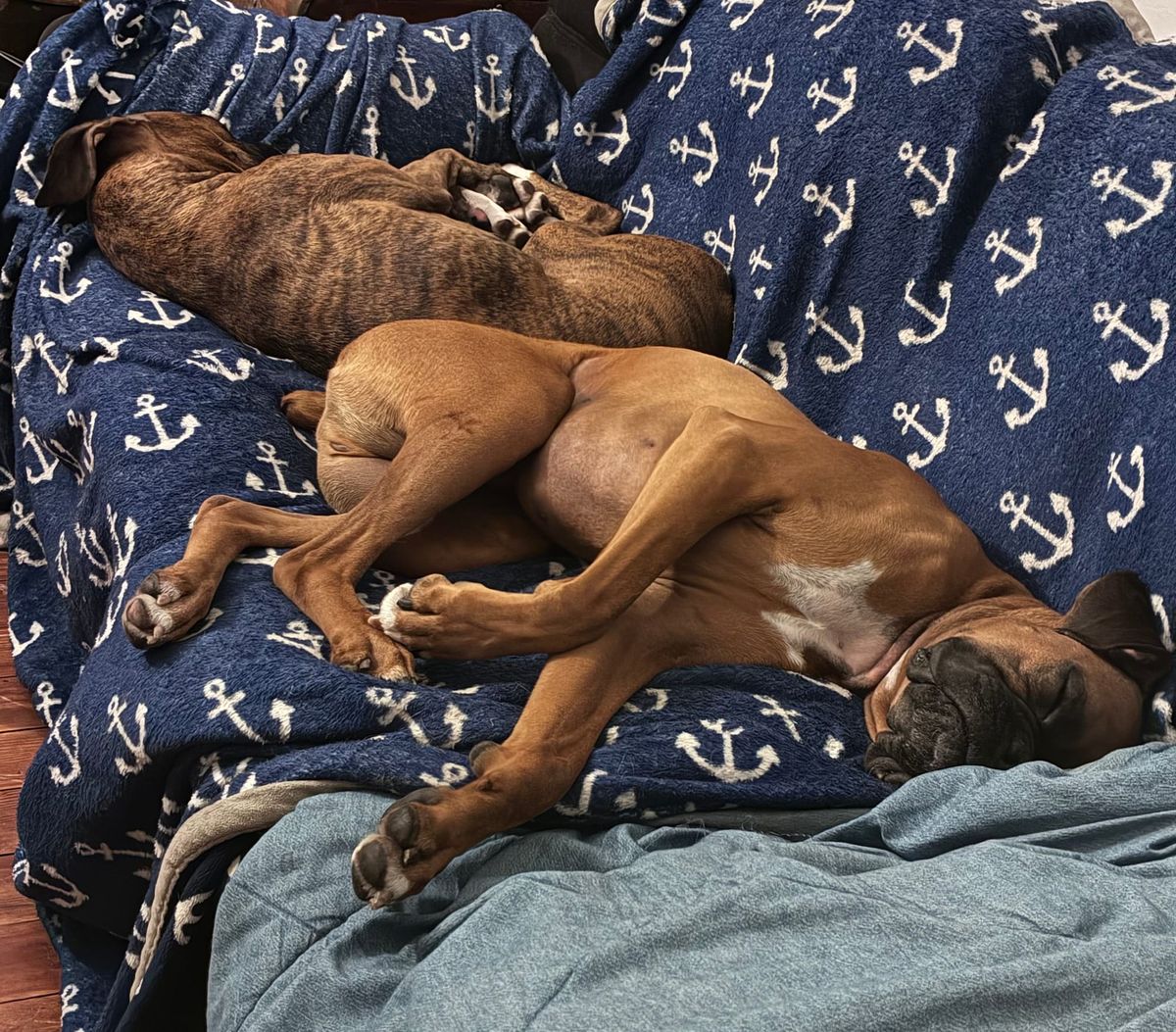
TL;DR: Many Boxer owners teach movement, play, and obedience but forget to teach rest. Boxers are energetic, emotional, people-centered working dogs, and many need help learning how to settle. The solution is not just more exercise. The solution is teaching an off switch through place training, calm routines, decompression, chews, crate comfort, and predictable rest windows.
The Boxer Off-Switch Problem
Some Boxers seem like they have no off switch.
They walk around the house.
They follow you everywhere.
They bring toys constantly.
They jump on and off furniture.
They bark for attention.
They pace after walks.
They wrestle when everyone is trying to relax.
They act like rest is personally offensive.
If this sounds familiar, you are not alone.
Many Boxer owners feel like their dog can move, play, run, and train — but cannot simply settle.
This is one of the most overlooked Boxer training problems.
Owners often focus on:
- sit
- stay
- leash walking
- recall
- not jumping
- not biting
- not barking
Those things matter.
But one of the most important skills your Boxer can learn is this:
“Nothing is happening right now, and I can relax.”
That is a trained skill.
Rest Does Not Always Come Naturally
Some dogs naturally settle easily.
Some Boxers do not.
Boxers are athletic, social, emotional, and highly involved in the home.
They want to participate.
They want to follow.
They want to play.
They want to know what is happening.
They want to be near their people.
That makes them wonderful companions.
But without structure, that same involvement can become restlessness.
A Boxer who never learns to settle may become:
- demanding
- clingy
- overexcited
- mouthy
- destructive
- reactive
- easily frustrated
- unable to relax indoors
The dog may not be trying to be difficult.
They may simply not know how to turn off.
Exercise Alone Does Not Teach Settling
This is the mistake many owners make.
They try to solve every behavior problem with more exercise.
More walking.
More fetch.
More play.
More running.
More dog park time.
Exercise matters.
Boxers absolutely need movement.
But if you only increase physical activity, you may create a dog with better endurance and the same poor self-control.
A Boxer can be physically tired and mentally overstimulated.
That dog may look wild even though they are exhausted.
Sometimes the answer is not more activity.
Sometimes the answer is recovery.
The Move → Think → Rest Framework
A balanced Boxer needs three things:
Move → Think → Rest
Move
Your Boxer needs physical outlets.
Examples:
- walks
- tug
- fetch in moderation
- recall games
- structured play
- safe running
- flirt pole work
Think
Your Boxer needs mental work.
Examples:
- training
- sniffing
- puzzle feeders
- impulse control
- scent games
- leash check-ins
- place practice
Rest
Your Boxer needs recovery.
Examples:
- crate time
- place command
- chew time
- lick mat
- quiet room
- nap window
- calm decompression
Many owners do the first two.
They forget the third.
But rest is where the nervous system learns to come down.
What Settling Actually Means
Settling does not mean your Boxer is asleep all day.
It means your Boxer can relax when nothing important is happening.
A Boxer who can settle may:
- lie on a bed while you work
- relax after a walk
- chew calmly instead of pacing
- stay on place when guests are over
- nap between activities
- rest in the crate
- watch the room without reacting to everything
That is not boring.
That is healthy.
A calm Boxer is not less Boxer.
A calm Boxer is a Boxer with better regulation.
Step 1: Create a Rest Spot
Your Boxer needs a clear place to relax.
This could be:
- dog bed
- raised cot
- crate
- mat
- blanket
- quiet corner
The location should be comfortable and predictable.
You are teaching:
“This is where calm happens.”
Use the same rest spot often so your Boxer begins to associate it with quiet behavior.
Step 2: Teach Place
Place is one of the most valuable commands for Boxer owners.
It gives your Boxer a job during calm moments.
Start simple.
Lead your Boxer to the mat or cot.
When they step on it, mark and reward.
Then release.
Repeat.
Gradually ask for:
- standing on place
- sitting on place
- lying down on place
- staying for longer periods
- relaxing while you move around
Keep early sessions short.
You are not forcing calm.
You are building it.
Step 3: Reward Calm Behavior
Many owners only notice their Boxer when they are being wild.
The dog jumps, barks, paws, steals something, or demands attention.
Then the owner reacts.
This can accidentally reward chaos.
Start noticing calm.
Reward your Boxer when they:
- lie down on their own
- relax on their bed
- chew quietly
- watch without reacting
- settle after activity
- choose calm instead of pestering
You do not always need to throw a party.
Sometimes calm praise or quietly dropping a treat is enough.
Teach your Boxer:
“Calm behavior pays.”
Step 4: Use Chews and Lick Mats
Chewing and licking can help many dogs relax.
After a walk, training session, or playtime, offer a calm activity.
Options:
- lick mat
- stuffed food toy
- safe chew
- frozen enrichment toy
- snuffle mat
- slow feeder
Use these as part of the come-down routine.
The sequence might be:
walk → water → place → lick mat → nap
Over time, your Boxer learns that activity is followed by recovery.
That rhythm matters.
Step 5: Schedule Rest Windows
Do not wait for your Boxer to collapse from exhaustion.
Build rest into the day.
Examples:
- rest after breakfast
- rest after walks
- rest after training
- rest during your work block
- rest before evening chaos
- rest before bedtime
A young Boxer may need help taking naps.
An overstimulated Boxer may resist rest at first.
That does not mean they do not need it.
It may mean they need more structure.
Step 6: Stop Rewarding Demand Behavior
If your Boxer barks, paws, nudges, or drops toys on you constantly, be careful.
If every demand creates play or attention, your Boxer learns to keep demanding.
Instead, create predictable engagement times.
You can absolutely play with your Boxer.
You should.
But play should not always begin because your Boxer harassed you into it.
Ask for calm first.
Then invite play.
Structure creates peace.
Step 7: Practice Calm When You Are Home
Do not only crate or separate your Boxer when you leave.
Practice calm while you are home too.
This helps your Boxer learn that quiet time is normal, not abandonment.
Use:
- place while you watch TV
- crate with the door open
- mat while you cook
- chew time while you work
- calm bed time while guests visit
Your Boxer should learn:
“I can be near my people without being involved in everything.”
That is a life-changing skill.
Step 8: Use a Calm Evening Routine
Evenings are hard for many Boxer owners.
Your dog may get wild when you are tired.
This is often when owners say:
“My Boxer loses their mind at night.”
Build an evening routine.
Example:
- short walk
- light training
- dinner
- potty break
- chew or lick mat
- place time
- lights lower
- calm interaction
- bedtime
A predictable evening rhythm can reduce late-day chaos.
Common Mistakes
Avoid:
- exercising your Boxer into exhaustion every day
- rewarding every demand for attention
- skipping mental work
- skipping rest windows
- expecting calm without teaching it
- using the crate only as punishment
- making every interaction high energy
- letting your Boxer rehearse chaos indoors
- assuming a tired dog automatically knows how to settle
Settling is not accidental.
It is built.
When Settling Problems May Be Something Else
If your Boxer suddenly cannot settle, seems uncomfortable, pants excessively, paces at night, seems anxious, or shows other changes, talk to your veterinarian.
Restlessness can sometimes be connected to:
- pain
- itching
- digestive discomfort
- anxiety
- age-related changes
- medication side effects
- environmental stress
Training is important, but health should always be considered.
A Simple Boxer Settle Routine
Try this after a morning or evening walk.
- Offer water.
- Take your Boxer to their place.
- Give a chew, lick mat, or calm enrichment item.
- Keep the environment quiet.
- Reward calm behavior.
- Let your Boxer nap or decompress.
- Repeat daily.
The pattern matters.
Your Boxer learns:
“After activity, we recover.”
That is the off switch.
Final Thought
Your Boxer does not need to be wild all day to be happy.
And your Boxer does not need to be exhausted to be calm.
They need fulfillment.
They need movement.
They need mental work.
They need structure.
And they need rest.
Teaching your Boxer to settle is not about removing their personality.
It is about helping them live with more balance.
A Boxer who can settle is easier to live with, easier to train, and often happier.
Because calm is not the opposite of joy.
Calm is what allows joy to fit into everyday life.
As always,
Happy bonding.
Helpful Products for Teaching Your Boxer to Settle
This section is a great place to add affiliate links.
These products can help create a calmer routine when used with structure and consistency.
Related Reading
- How to Build a Calm Morning Routine for Your Boxer
- Why Your Boxer Has Endless Energy
- Understanding the Working Boxer
- The Walk: What It Means for You and Your Boxer
- How to Strengthen Your Boxer’s Bond Without Creating Anxiety
Affiliate disclosure: TheBoxerBond may earn from qualifying purchases — at no extra cost to you.
© 2025 · Made with love & care in Austin, Texas · TheBoxerBond