My Boxer Has Endless Energy No Matter How Much I Exercise Them: Why More Exercise Is Not Always the Answer

TL;DR: Many Boxer owners accidentally build better athletes instead of calmer dogs. If your Boxer seems to have endless energy, the solution is not always more running, more fetch, or longer walks. Boxers need balance: movement, mental work, structure, and rest. The goal is not to exhaust your Boxer into calmness. The goal is to teach regulation through the Move → Think → Rest framework.
The Boxer Energy Problem
Boxers are famous for their energy.
They bounce.
They wiggle.
They sprint.
They play.
They leap.
They throw their bodies into life.
That is part of the breed.
But many owners eventually reach a point where they ask:
“Why does my Boxer still have energy after everything I do?”
You walked them.
They are still wild.
You played fetch.
They are still pacing.
You let them run.
They are still jumping.
You gave them exercise, and somehow they came home stronger.
That is when many Boxer owners start to feel stuck.
They think:
“Maybe I just need to exercise them more.”
Sometimes that is true.
But often, the problem is not too little exercise.
The problem is unbalanced fulfillment.
You May Be Building an Athlete
This is one of the biggest Boxer ownership mistakes.
Owners try to fix energy with more and more physical activity.
Longer walks.
More fetch.
More running.
More wrestling.
More chaos.
But the dog does not necessarily become calmer.
They become fitter.
You may accidentally build an athlete with no off switch.
A Boxer who can run longer, play harder, recover faster, and still not settle is not unusual.
Exercise matters.
But exercise alone does not teach calmness.
A Boxer can be physically tired and mentally overstimulated at the same time.
That is why the goal cannot be only:
“How do I wear my Boxer out?”
The better question is:
“How do I fulfill my Boxer and teach them to come down afterward?”
That is a different approach.
Boxers Need More Than Movement
Boxers are working dogs with family-dog hearts.
They need physical activity, but they also need mental purpose.
A Boxer needs:
- movement
- mental work
- structure
- calm leadership
- problem-solving
- boundaries
- recovery
- rest
If your Boxer gets only movement, they may stay emotionally revved up.
Think about it like this:
Running uses the body.
Training uses the brain.
Rest teaches regulation.
A balanced Boxer needs all three.
The Move → Think → Rest Framework
This is one of the most important Boxer Bond principles.
Move → Think → Rest
Your Boxer needs each part.
Move
This gives the body an outlet.
Examples:
- walking
- tug
- fetch in moderation
- flirt pole
- hiking
- controlled play
- recall games
- structured exercise
Think
This gives the brain a job.
Examples:
- obedience
- scent games
- puzzle feeders
- place training
- leash check-ins
- food scatter games
- impulse control
- trick training
Rest
This teaches the nervous system how to come down.
Examples:
- crate time
- place command
- chew time
- lick mat
- quiet room
- nap window
- post-walk decompression
If your Boxer is missing one of these, behavior problems can grow.
Movement without thinking can create wild fitness.
Thinking without movement can leave the body underused.
Stimulation without rest can create a dog who cannot settle.
Balance is the goal.
Why More Exercise Can Backfire
More exercise is not bad.
Boxers need it.
But if every day becomes high-adrenaline activity, your Boxer may begin to expect that level of stimulation.
Examples of high-arousal activities include:
- intense fetch
- rough wrestling
- constant dog park play
- frantic tug
- chasing games
- off-leash sprinting with no structure
These activities can be useful in moderation.
But if they are the only outlet, your Boxer may become harder to settle.
High-arousal activity should be followed by calming work.
That means after intense movement, you help your Boxer come down.
Not more chaos.
Recovery.
Signs Your Boxer Needs Mental Work
Your Boxer may need more mental stimulation if they:
- pace after exercise
- demand bark
- destroy things when bored
- struggle to settle
- constantly seek attention
- ignore you outside
- get into trouble after walks
- seem physically tired but mentally restless
- need constant entertainment
A mentally underworked Boxer often creates their own job.
That job might be chewing furniture, barking at windows, stealing items, or harassing the household for attention.
That is not because they are bad.
It is because their brain needs direction.
Signs Your Boxer Needs Rest Training
Your Boxer may need help learning to rest if they:
- cannot relax after exercise
- follows you constantly
- jumps up every time you move
- does not nap enough
- gets mouthy when tired
- demand barks after play
- becomes wild in the evening
- struggles with crate or place time
- seems more chaotic when exhausted
This is where many owners miss the point.
Sometimes your Boxer does not need more activity.
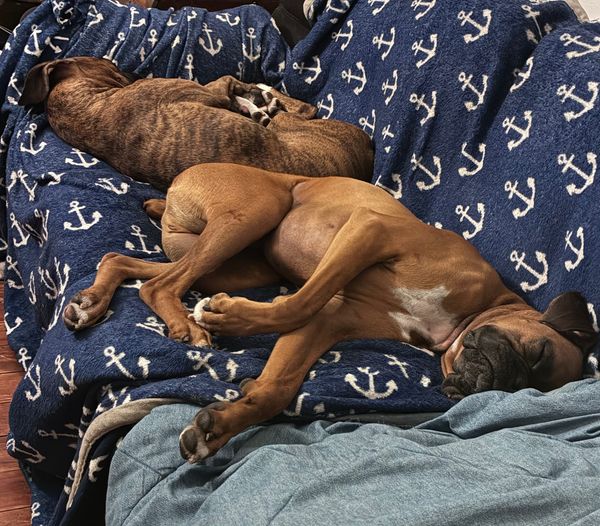
Sometimes they need help stopping.
An overtired Boxer can look like an under-exercised Boxer.
That is why rest is not laziness.
Rest is training.
Build a Better Daily Rhythm
A calmer Boxer usually has a better daily rhythm.
That rhythm might look like:
- morning potty and structured walk
- short training session
- breakfast with a slow feeder or puzzle
- rest window
- midday enrichment
- afternoon walk or play
- calm chew or place time
- evening walk
- quiet decompression before bed
The point is not to copy this exactly.
The point is to create predictable cycles.
Activity.
Thinking.
Recovery.
Your Boxer learns what comes next.
That predictability helps create calm.
The Calm Morning Routine
Mornings matter.
If your Boxer starts the day with chaos, they may carry that energy forward.
A strong morning routine might include:
- calm wake-up
- potty break
- structured walk
- short training
- breakfast with intention
- post-breakfast rest
The first hour does not need to be perfect.
It needs to be predictable.
Your Boxer should not start every morning in a frantic state.
Start calm.
Guide the energy.
Teach the come-down.
Use Food as Mental Work
Do not waste every meal in a bowl.
Food can become training and enrichment.
Try:
- slow feeder bowls
- puzzle feeders
- snuffle mats
- scatter feeding
- frozen lick mats
- training sessions with kibble
- treat-dispensing toys
This turns mealtime into brain work.
A Boxer who works for food often feels more fulfilled than a Boxer who inhales food in thirty seconds.
Teach Place
Place training is one of the best tools for high-energy Boxers.
It teaches:
- impulse control
- calmness
- boundaries
- independence
- recovery
- household manners
Your Boxer learns:
“I can be near my people without being involved in everything.”
That is huge.
Start with short durations.
Reward calm behavior.
Build slowly.
Do not expect your Boxer to stay on place for an hour on day one.
Teach it like a skill.
Avoid the Constant Entertainment Trap
Boxers love interaction.
But if you entertain your Boxer every time they demand attention, you may teach them that pestering works.
Your Boxer should get plenty of engagement.
But they also need to learn that not every moment is playtime.
This is especially important for people who work from home, live in apartments, or have young energetic dogs.
A Boxer who cannot handle boredom will struggle in normal life.
Teach calm independence.
That is part of responsible ownership.
A Simple Daily Energy Formula
Try this:
Morning
Move: structured walk
Think: 3–5 minutes of training
Rest: place, crate, or chew time
Midday
Move: potty walk or light play
Think: puzzle feeder or sniff game
Rest: quiet time
Evening
Move: walk, tug, or controlled play
Think: obedience or scent work
Rest: decompression before bed
This gives your Boxer what they need without turning the whole day into chaos.
When to Consider Health or Anxiety
If your Boxer’s energy feels extreme, sudden, or paired with other concerning symptoms, talk to your veterinarian.
Sometimes restlessness can be connected to:
- pain
- itching
- digestive discomfort
- anxiety
- lack of sleep
- medical issues
- medication effects
Training matters, but health matters too.
A dog who is uncomfortable may struggle to settle.
Final Thought
Your Boxer may not need more exercise.
They may need better fulfillment.
Movement matters.
But so does mental work.
And so does rest.
The goal is not to exhaust your Boxer into becoming easier to live with.
The goal is to build a Boxer who can move, think, and recover.
That is how you create calm.
That is how you build balance.
That is how you strengthen the bond.
As always,
Happy Bonding Y'all
Helpful Products for High-Energy Boxers
- snuffle mat
- puzzle feeder
- slow feeder bowl
- lick mat
- flirt pole
- tug toy
- place cot
- long line
- treat pouch
- durable chew toy
These tools help support the Move → Think → Rest framework when used with structure.
Related Reading
- How to Build a Calm Morning Routine for Your Boxer
- The Walk: What It Means for You and Your Boxer
- Understanding the Working Boxer
- How to Teach Your Boxer to Settle
- Indoor Boxer Games: No Yard Needed
Affiliate disclosure: TheBoxerBond may earn from qualifying purchases — at no extra cost to you.
© 2025 · Made with love & care in Austin, Texas · TheBoxerBond